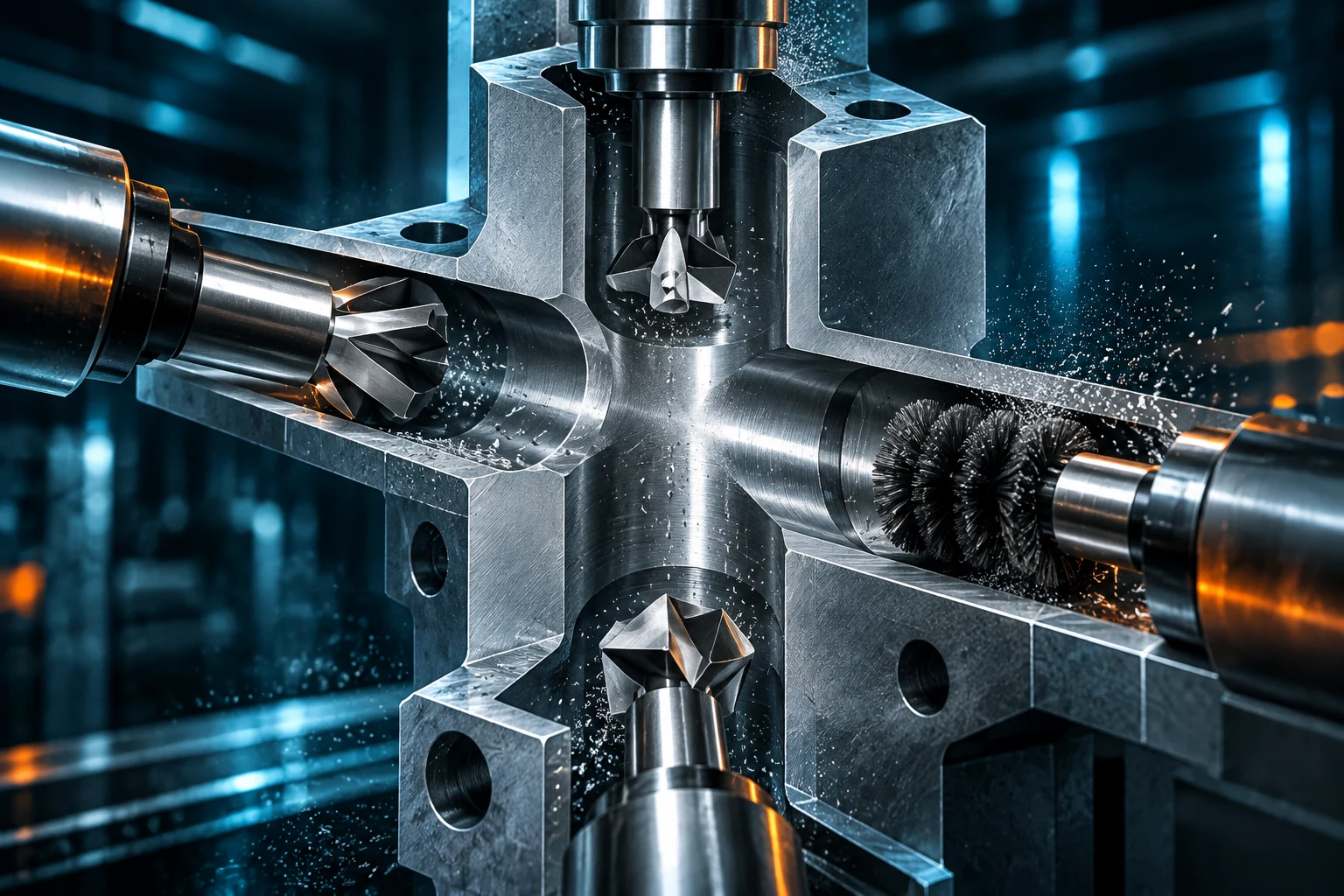
Mechanical Deburring
with Tools
Mechanical deburring removes burrs by the direct action of a tool on the part edge. It is one of the most widely used deburring methods and can be performed manually, on a CNC machine tool or fully automated. Specialised tools also allow some internal edges and bore intersections to be deburred mechanically.
How Mechanical
Deburring Works
The tool mechanically contacts the edge and removes material in a controlled way. Tools are used with:
Defined cutting edge
Milling cutters, countersinks and special deburring blades with a defined edge produce a defined chamfer or radius.
Undefined / flexible tools
Brushes and abrasive tools, plus compliant or compensating tools that follow the part geometry — including tools designed for back edges of holes and bore intersections.
Edge state control
The tool may merely break the sharp edge, produce a defined chamfer or radius, or affect the surface. The required edge state must be known before the process is selected.
Where Mechanical Deburring
Is Used
Typical applications cover every edge a suitable tool can reach — not only simple parts.
External edges & hole edges
Entry and exit edges of drilled holes, machined faces and well-accessible internal edges.
Bore intersections
Some bore intersections can be deburred with specialised spring, telescoping, compensating or orbital tools.
Castings & weldments
Cast, machined and welded parts deburred manually or with robotic systems integrated into the production line.
Inline CNC & robotic cells
With a suitable tool the process integrates directly into machining centres, automated lines and robotic workcells.
Why Mechanical Deburring with Tools
- One of the most versatile deburring technologies
- Precise treatment of exactly the required edge
- Easy integration into machining and automated production
- Specialised tools reach some internal edges and bore intersections
- Defined chamfer or radius possible where required
- High process stability with CNC and robotic control
- Works on all metals and most engineering materials
- No chemistry, no temperature — simple process
Mechanical vs. Alternative Methods
| Feature | Mechanical | TEM | ECM |
|---|---|---|---|
| Bore intersections | ~ With special tools | ✔ Excellent | ✔ Excellent |
| Many internal edges at once | ✖ One path per edge | ✔ All simultaneously | ✔ All simultaneously |
| Defined chamfer / radius | ✔ Yes | ✖ Edge break only | ~ Small radius |
| Machining cycle impact | ~ Adds cycle time | ✖ Separate process | ✖ Separate process |
| Edge geometry unchanged | ~ Depends on tool | ✔ Yes | ✔ Yes |
Frequently Asked Questions
Send us your drawing
Share a PDF, DWG or photo of the part. We will recommend the right deburring method and provide a no-obligation quote within 24 hours.
Send Drawing or Photo