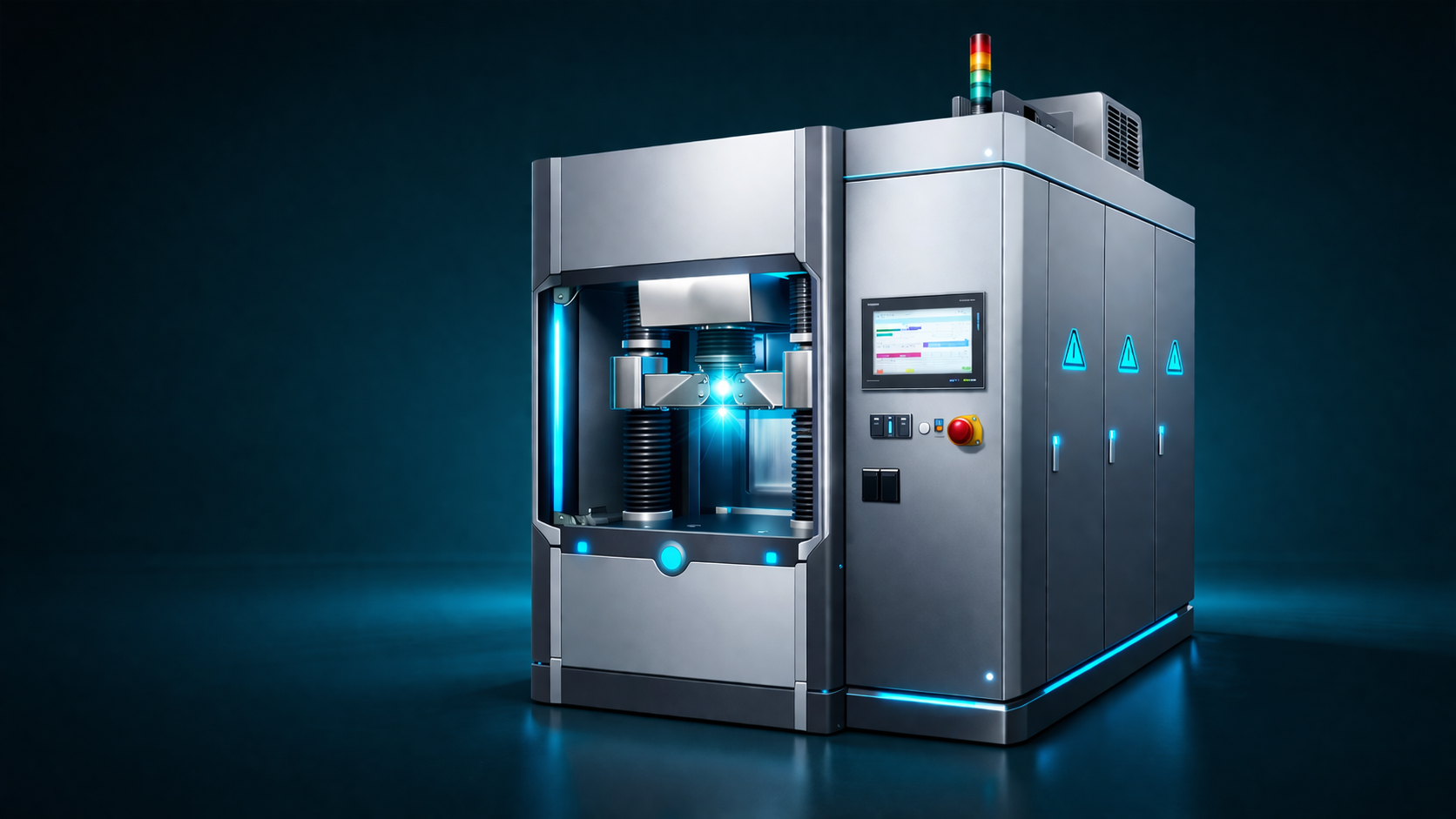
Electrochemical Deburring
(ECM)
Electrochemical Machining (ECM) removes burrs by controlled anodic dissolution in electrolyte solution. The process is inherently selective — current density peaks at burr tips, dissolving them preferentially without affecting part geometry.
Visualization — Principle of Electrochemical Deburring

Controlled anodic dissolution: current density peaks at burr tips, selectively removing them without mechanical contact or thermal stress.
How Electrochemical
Deburring Works
The workpiece acts as the anode (+). A shaped cathode tool (−) is positioned at the target location. Electrolyte flows through the gap and electrical current is applied.
Anodic dissolution
Electrical current causes controlled dissolution of metal at the workpiece surface (anode). No material removal on the tool.
Selective action
Current density is highest at burr tips — they dissolve first and fastest. The base surface is largely unaffected.
Material carry-off
Dissolved material is flushed away by the electrolyte flow. The process leaves a smooth, defined edge radius.
Where ECM
Is Used
ECM is the preferred choice for precision parts where cross-hole burrs must be removed without any mechanical contact or thermal influence.
Hydraulic manifolds & valve bodies
Cross-hole burrs in high-pressure hydraulic blocks are selectively dissolved. No residual particles — compliant with NAS and ISO cleanliness standards.
Fuel injection components
Nozzles, injector bodies and common rail components require burr-free precision bores. ECM achieves this without altering the bore geometry.
Precision engineering
Hardened steel parts, tight tolerances, complex internal geometries — ECM works regardless of material hardness.
Pneumatic components
Precision spool valves and actuator bores are deburred without tool marks or surface distortion.
Why ECM
- Precisely targeted — acts only where the cathode is positioned
- No mechanical contact — zero risk of surface damage or tool marks
- No thermal influence — no HAZ, no distortion
- Works on hardened steel and difficult-to-machine materials
- Defined edge radius — not just burr removal, but controlled edge conditioning
- No tool wear — cathode life is virtually unlimited
- Stable, repeatable process for series production
- Produces smooth surfaces in the processed zone
ECM vs. Alternative Methods
| Feature | ECM | TEM | Mechanical |
|---|---|---|---|
| Cross-hole burrs | ✔ Excellent | ✔ Excellent | ✖ Not reachable |
| No mechanical contact | ✔ Yes | ✔ Yes | ✖ No |
| No thermal stress | ✔ Yes | ~ Surface ~100 °C | ✔ Yes |
| Hardened materials | ✔ Yes | ✔ Yes | ✖ Difficult |
| Multiple parts per cycle | ~ Fixture-dependent | ✔ Yes | ✖ One at a time |
| Edge radius control | ✔ Precise | ~ Limited | ~ Tool-dependent |
Frequently Asked Questions
Send us your drawing
Share a PDF, DWG or photo of the part. We will recommend the right deburring method and provide a no-obligation quote within 24 hours.
Send Drawing or Photo