Chemical Bath Deburring
(CBE)
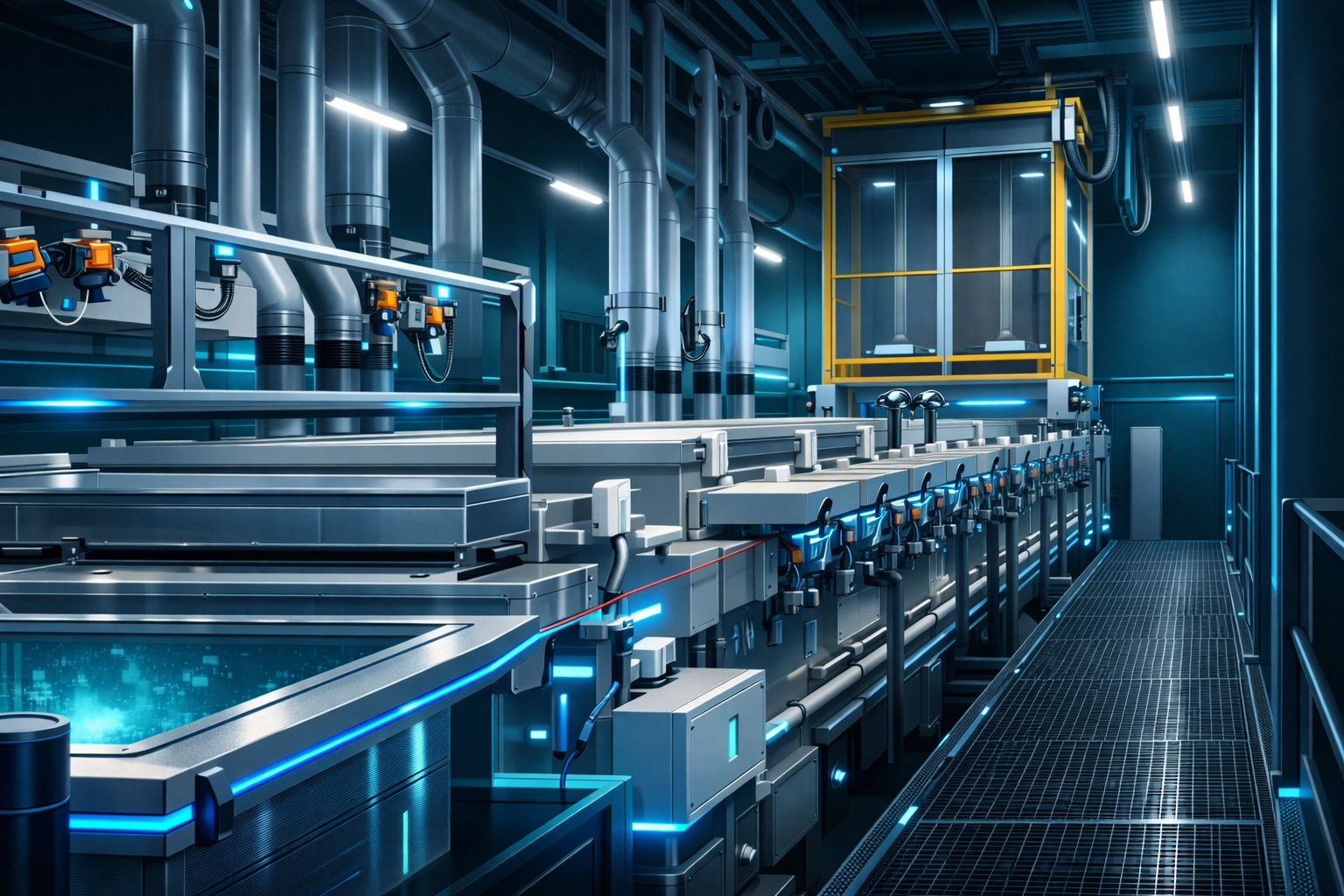
Chemical Bath Deburring (CBE) exploits the geometry of burrs: their high surface-to-mass ratio causes them to dissolve faster than the base material in a controlled chemical bath. Fine burrs are removed completely — without any mechanical contact.
How Chemical
Deburring Works
Parts are immersed in a precisely formulated chemical solution. Burrs — due to their thin cross-section — dissolve preferentially while the part surface is barely affected.
Immersion
Parts are placed in baskets and immersed in the chemical bath. Hundreds of small parts can be processed in a single batch.
Selective dissolution
Burrs dissolve preferentially due to their high surface-to-mass ratio. The reaction is self-limiting — stops naturally once the burr is gone.
Rinse & neutralise
Parts are rinsed and neutralised. Surfaces receive a light chemical brightening effect — ready for further processing.
Where CBE
Is Used
CBE is ideal for small, complex parts with multiple burr locations that are impractical to deburr individually.
Small precision parts
Gears, shims, stampings and small turned parts with thin burrs across many edges — entire batches processed in one cycle.
Zinc and aluminium die-castings
HPDC and gravity die-cast parts with parting-line flash and thin internal burrs. CBE selectively removes flash without dimensional impact.
Hydraulic & pneumatic components
Spool valves, orifice plates and distributor blocks where fine burrs in precision bores must be removed without dimensional change.
Electronics & connectors
Stamped or machined connector housings where burrs on contact surfaces must be removed without affecting plating or coating.
Why CBE
- Batch processing — high throughput, low per-part cost
- Reaches all surfaces simultaneously — internal and external
- Self-limiting reaction — stops when the burr is gone
- No mechanical stress — no risk of part deformation
- No thermal stress — suitable for sensitive alloys
- Consistent results across an entire batch
- Suitable for parts with complex geometries and many burr locations
- Light surface brightening as a secondary benefit
CBE vs. Alternative Methods
| Feature | CBE | TEM | Vibratory |
|---|---|---|---|
| Batch processing | ✔ Excellent | ✔ Multiple parts | ✔ Yes |
| Internal burrs | ✔ All surfaces | ✔ Yes | ✖ External only |
| No mechanical stress | ✔ Yes | ✔ Yes | ✖ Abrasive contact |
| Burr thickness limit | Fine burrs only | All thicknesses | Thin burrs |
| Cycle time | 15–30 min | < 1 min | 30–120 min |
| Investment cost | Low–Medium | Medium | Low |
Frequently Asked Questions
Send us your drawing
Share a PDF, DWG or photo of the part. We will recommend the right deburring method and provide a no-obligation quote within 24 hours.
Send Drawing or Photo