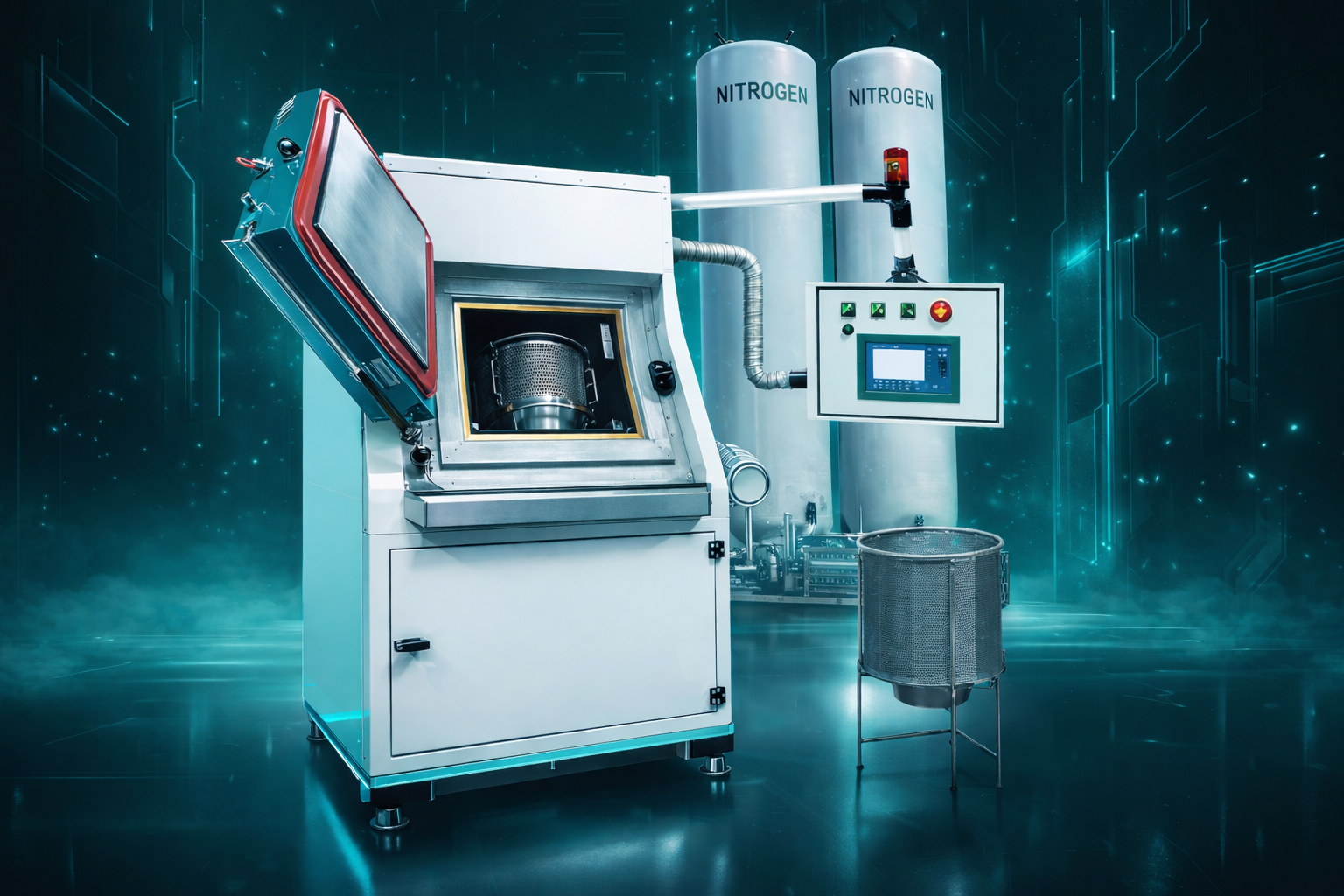
Cryogenic Deburring
(CRYO)
Parts are cooled with liquid nitrogen to below −90 °C. Burrs and flash embrittle at this temperature and are mechanically removed by tumbling media — without distorting the part.
How Cryogenic
Deburring Works
The freezing point of a burr is reached before the part deforms. At cryogenic temperatures, thin burrs become brittle while the part core stays intact.
Cooling
Parts are loaded into the cryogenic drum. Liquid nitrogen chills the chamber to −90 °C or below within minutes.
Embrittlement
Thin burrs reach their glass transition temperature and become brittle. The part body, being thicker, remains flexible.
Mechanical removal
The drum tumbles with plastic or dry-ice media. Embrittled burrs snap off cleanly — the part surface is unaffected.
Where CRYO
Is Used
CRYO is the standard method for burr removal on injection-moulded plastics, rubber seals and thin-walled die-castings.
Injection-moulded plastics
Parting-line flash, gate vestiges and ejector pin marks are removed cleanly without distorting the part.
Rubber & elastomer seals
O-rings, gaskets and moulded seals are deburred without mechanical damage to sealing surfaces.
Thin-wall HPDC flash
External flash on thin-walled aluminium and zinc die-castings is removed gently. For internal burrs in HPDC, TEM is the primary recommendation.
Precision plastic components
Connectors, housings and miniature parts where conventional deburring would risk deformation.
Why CRYO
- Removes burrs from plastics and elastomers without distortion
- Batch processing — hundreds of parts per cycle
- No solvents, chemicals or abrasives
- Consistent, repeatable results
- Suitable for parts with complex geometry and many burr locations
- Clean process — no residue on parts
- Short cycle time — typically 15–30 minutes
- Parts ready for further processing immediately after
CRYO vs. Alternative Methods
| Feature | CRYO | Manual | TEM |
|---|---|---|---|
| Plastics & elastomers | ✔ Excellent | ~ Possible | ✖ Not suitable |
| Batch processing | ✔ Yes | ✖ One at a time | ✔ Yes |
| Internal burrs (metal) | ✖ Not suitable | ✖ Limited | ✔ Excellent |
| No chemical waste | ✔ Yes | ✔ Yes | ✔ Yes |
| Thin-wall HPDC flash | ✔ External flash | ~ Careful | ✔ Internal + external |
| Investment cost | Low–Medium | Very low | Medium |
Frequently Asked Questions
Send us your drawing
Share a PDF, DWG or photo of the part. We will recommend the right deburring method and provide a no-obligation quote within 24 hours.
Send Drawing or Photo