Hot Air
Deburring
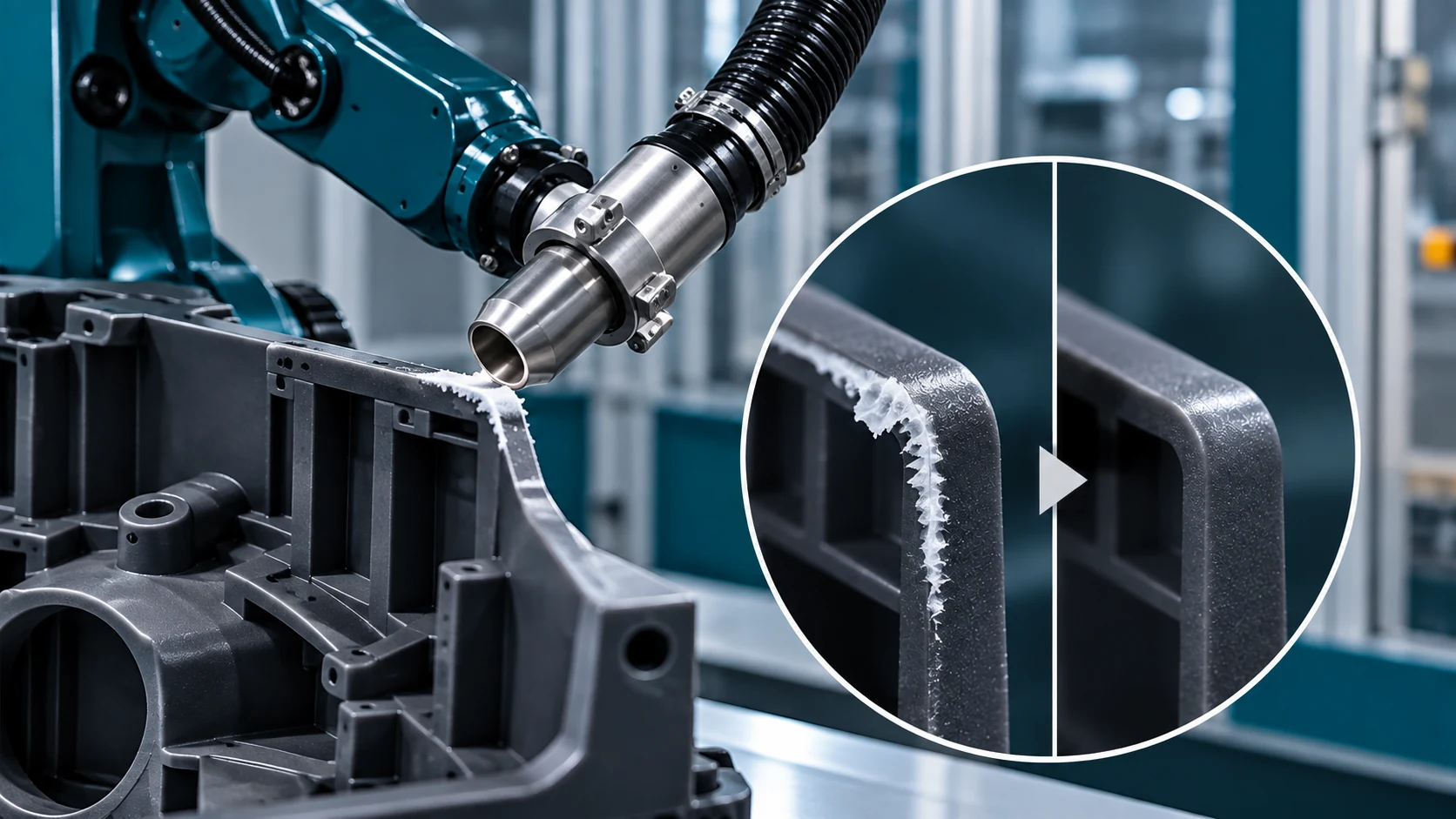
A precisely temperature-controlled hot air stream melts and re-fuses fine plastic burrs, parting-line flash and membrane remnants — without any mechanical contact. Designed for inline integration in injection-moulding production.
How Hot Air
Deburring Works
Hot air at precisely controlled temperature and flow rate is directed onto the burr location. The thin burr melts and re-fuses with the base surface.
Temperature profiling
Air is heated to the exact melt temperature of the plastic — typically 10–30 °C above the burr melting point. Too hot risks distortion; too cool leaves flash.
Robot-guided nozzle
A robot arm guides the hot air nozzle along the part perimeter following a pre-programmed path. No mechanical contact with the part.
Melt & re-fusion
The thin burr melts and re-fuses with the parent surface — leaving a clean, smooth edge with no visible transition.
Where Hot Air Deburring
Is Used
Hot air deburring is the standard non-contact deburring process for automotive plastic interior and exterior trim components.
Automotive interior trims
Dashboard panels, door trims and pillar covers are deburred inline after injection moulding — before painting or assembly.
Bumpers & exterior plastics
Parting-line flash on large exterior plastic parts is removed by robot-guided hot air nozzles inline with the injection press.
Electronics housings
Thin-wall plastic enclosures and connector housings are deburred without risk of warping or dimensional change.
Technical plastic components
Precision plastic valves, clips and brackets with fine flash are processed in robotic cells integrated into the production line.
Why Hot Air Deburring
- Non-contact — zero mechanical stress on the part
- Inline integration directly after injection moulding
- Robot-guided — fully automatable
- No tooling wear — hot air nozzle has unlimited life
- Clean re-fusion of burr material — no debris generated
- Suitable for all engineering thermoplastics
- Cycle time matches injection press cycle
- Reduces manual finishing labour to near zero
Hot Air vs. Alternative Methods
| Feature | Hot Air | CRYO | Manual |
|---|---|---|---|
| Inline integration | ✔ Yes | ✖ Separate batch | ✖ No |
| Non-contact | ✔ Yes | ✔ Yes | ✖ No |
| Metals | ✖ Plastics only | ~ Thin-wall only | ✔ Yes |
| Cycle time | Matches press cycle | 15–30 min batch | Manual speed |
| Investment cost | Medium | Low–Medium | Very low |
Frequently Asked Questions
Send us your drawing
Share a PDF, DWG or photo of the part. We will recommend the right deburring method and provide a no-obligation quote within 24 hours.
Send Drawing or Photo