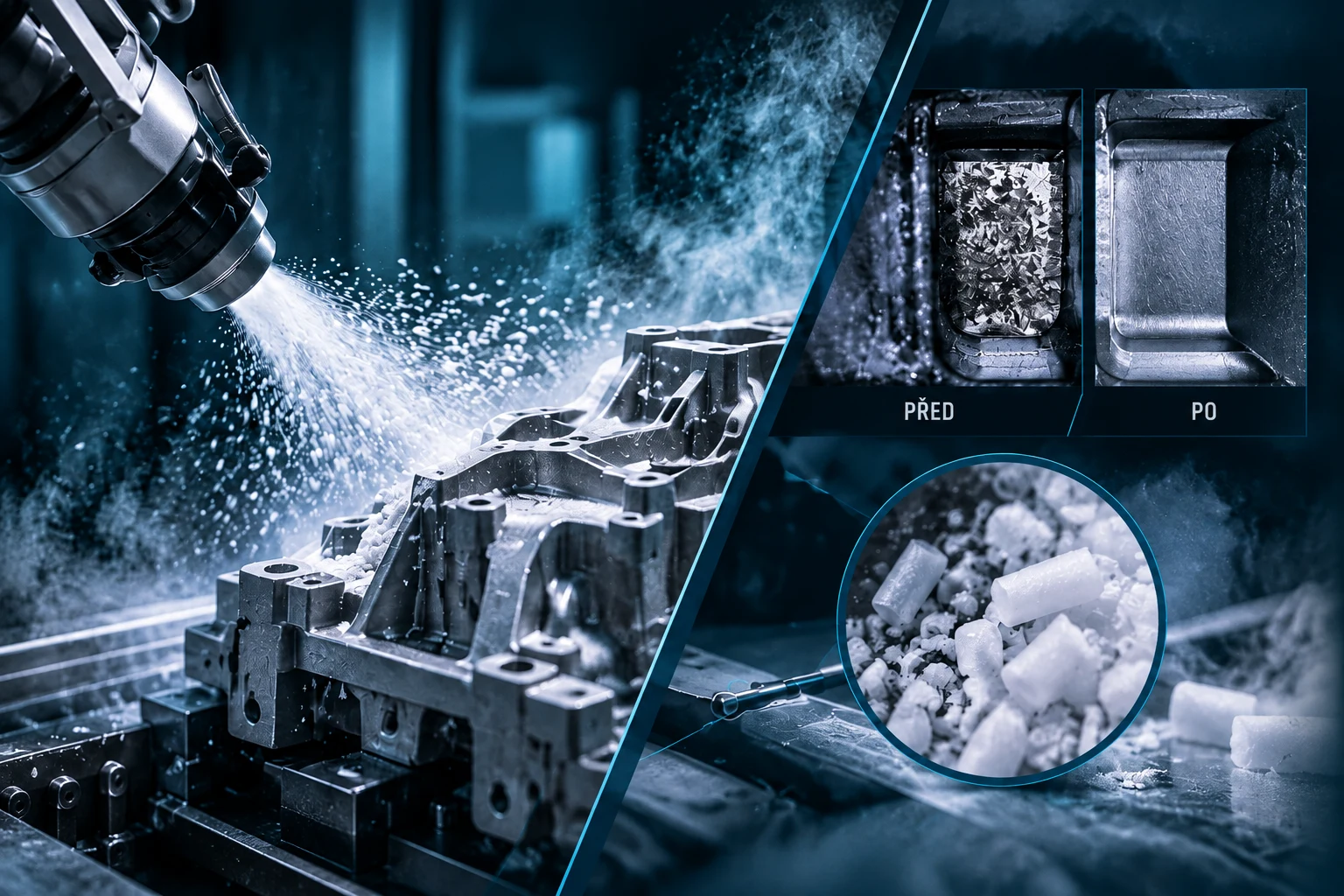
CO₂ Blasting
(Dry Ice)
Solid CO₂ pellets are accelerated and impacted onto the part surface. On contact, they sublimate instantly — the combined kinetic, thermal and expansion effect removes fine burrs and contamination without secondary waste.
How CO₂ Blasting
Works
Dry ice pellets (−78 °C) are fed into a blast nozzle and propelled by compressed air. Impact, sublimation and thermal shock dislodge contaminants and fine burrs.
Pellet acceleration
CO₂ pellets are accelerated to high velocity in a compressed air stream. No abrasive media is required.
Triple-action removal
On impact: (1) kinetic energy dislodges burr / contaminant; (2) thermal shock embrittles the surface layer; (3) sublimation gas expands under the contamination and lifts it off.
Zero secondary waste
CO₂ sublimates completely — only the removed burr / contamination remains for collection. No liquid, no abrasive residue.
Where CO₂ Blasting
Is Used
CO₂ blasting is the preferred method when contamination from wet or abrasive processes is unacceptable.
Electronics & PCB assemblies
Flux residues and fine burrs removed without moisture or abrasive contamination of sensitive circuitry.
Plastic injection-moulded parts
Mould release residues and fine parting-line flash removed without solvent or abrasive damage to the part.
Optical & precision instruments
Contamination removed from lenses, mirrors and precision housings without contact damage.
Food industry equipment
Machine parts and production equipment cleaned in-situ — no moisture, no chemical residue, HACCP-compatible.
Why CO₂ Blasting
- Zero secondary waste — CO₂ sublimates completely
- No moisture, no solvents, no abrasive residue
- Non-conductive — safe for electrical components
- Gentle on substrates — no surface damage
- Portable — can be used in-situ on installed equipment
- No waste disposal costs for blasting media
- Suitable for plastics, electronics and food-contact surfaces
- Fast — removes contamination on contact
CO₂ Blasting vs. Alternative Methods
| Feature | CO₂ | Abrasive Blast | Ultrasonic |
|---|---|---|---|
| No secondary waste | ✔ Zero | ✖ Media residue | ✔ Clean |
| Sensitive substrates | ✔ Yes | ✖ Aggressive | ✔ Yes |
| In-situ use | ✔ Portable | ~ Cabinet needed | ✖ Tank needed |
| Heavy burrs | ✖ Fine only | ✔ Yes | ✖ Fine only |
| Investment cost | Low–Medium | Low–Medium | Low–Medium |
Frequently Asked Questions
Send us your drawing
Share a PDF, DWG or photo of the part. We will recommend the right deburring method and provide a no-obligation quote within 24 hours.
Send Drawing or Photo